Free Shipping Over £50
Non-Toxic Laundry Detergent in the UK: What the Label Actually Tells You
Share
"Non-toxic laundry detergent" is one of the most searched phrases that brings people to this site, and I understand why. It's the phrase I typed into Google myself, during lockdown, when I started questioning what was actually in the bottles under my sink. It's also, I've come to think, one of the least useful phrases on a label. So rather than tell you our detergent is non-toxic, I'd rather show you how to read a label properly and then show you ours.
What "non-toxic" means on a UK label
Legally, nothing. "Non-toxic" isn't a defined or regulated term for household detergents in the UK. Any brand can print it, and the only real check is after the fact: the Competition and Markets Authority's Green Claims Code says claims must be truthful, clear and unambiguous, and backed by evidence. Vague, general claims are exactly the kind the CMA says are most likely to mislead. "Non-toxic" is about as general as it gets: toxic to whom, at what dose, compared with what?
What the law does require is more useful. Under the detergent regulations that apply in Great Britain (Regulation (EC) 648/2004, overseen by HSE), every detergent must:
- List its ingredient types on the pack in percentage bands (under 5%, 5–15%, 15–30%, 30% and over).
- Name any of the recognised fragrance allergens present above 0.01% by weight, whether the fragrance is synthetic or a natural essential oil.
- Publish a full ingredient list that the public can read, typically on the brand's website.
That last point is the one I'd lean on. If a brand calls itself non-toxic but you can't find a complete ingredient list anywhere, the word is doing the work the ingredients should be doing.
Four things I'd look at instead
1. Is the full ingredient list published, with plain-English explanations?
"Plant-based" and "naturally derived" tell you where an ingredient started, not what it is now or what it does. A brand that's confident in its formula will list every ingredient and explain why it's there. Ours is on the product page, ingredient by ingredient, and I'll walk through it below.
2. Does it contain enzymes?
Enzymes (proteases, amylases, lipases) are what make a "bio" detergent bio. They break down protein, starch, and fat stains at low temperatures, and they're very effective. Some people prefer to avoid them, particularly for skin that reacts easily or for washing next-to-skin items, which is why non-bio exists as a category. Neither choice is wrong; it depends on your household. I've written more about the difference between bio vs non-bio laundry detergent.
3. Does it contain optical brighteners?
Optical brighteners are fluorescent additives that stay on the fabric after rinsing and reflect ultraviolet light back as blue-white light. Your whites look whiter; they aren't any cleaner. Most mainstream detergents use them, and most don't mention it on the front of the pack. If you'd rather your clothes weren't carrying a coating designed to stay put, it's worth checking the ingredient list for them.
4. How is it scented, and do you need it unscented?
Synthetic fragrance in detergent is usually a blend of undisclosed compounds, often held on the fabric with fixatives. Essential oils are a different route: a named plant oil at a known percentage. But essential oils are still fragrance. They contain naturally occurring allergens (in ours, limonene and linalool) which by law are listed on the pack, and they can irritate skin that reacts to fragrance of any kind.
So, if you have a diagnosed fragrance allergy, or a dermatologist has told you to avoid fragrance altogether, you want a fragrance-free detergent, and ours isn't one. Our detergent is scented with lavender, geranium, and bergamot essential oils at under 1%. If you're sensitive rather than allergic, most customers with reactive skin get on well with it, but I'd always suggest a patch test on an inside seam first, and I'd never promise you otherwise.
What I chose for ours, and why
When I formulated our laundry detergent, I made a list of what to leave out before the list of what to put in. Here's both.
Left out: enzymes; optical brighteners; synthetic fragrance; dyes; sulphates (SLS and SLES); phthalates; microplastics; EDTA; parabens and phenoxyethanol.
Put in:
- Two plant-sugar surfactants (caprylyl/capryl glucoside and decyl glucoside), made from coconut oil and glucose. These do the actual cleaning. They're mild, readily biodegradable, and they keep working in hard water.
- Washing soda and citric acid to soften the water and lift grease, which matters more than people think if you live somewhere with hard water.
- Xanthan gum, a fermentation-derived thickener, blended into vegetable glycerin so the liquid stays smooth. No synthetic polymers.
- A preservative system of benzyl alcohol and sodium benzoate, used in small amounts so the bottle stays fresh once it's open. Every water-based product needs one; I'd be suspicious of any that claims it doesn't.
- Essential oils of lavender, geranium and bergamot, under 1% in total.
[product=gentle-laundry-detergent]
✓ Enzyme-free, no optical brighteners or dyes
✓ Scented only with lavender, geranium and bergamot essential oils
✓ Refillable aluminium forever bottle, made in Wales
[/product]
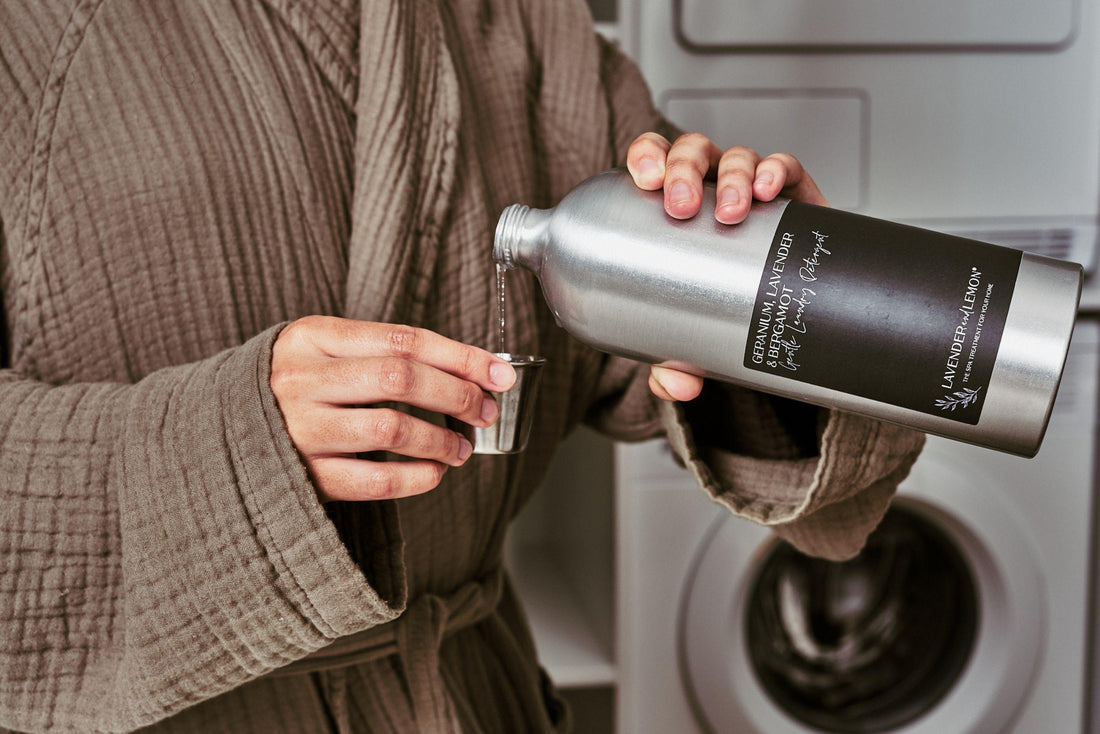
It comes in a 950 ml aluminium forever bottle, and when you're through it you buy a refill rather than another bottle. There's a 5-litre refill box for households that get through a lot of washing. Everything is made in small batches at my studio in Wales. In June 2026, The English Home included it in their round-up of the best non-toxic laundry detergents, which I was pleased about and slightly amused by, given everything I've just said about the phrase “non-toxic”.
Getting the dose right
Most people use too much detergent, and most of the "my clothes don't feel clean" complaints I hear come down to water hardness rather than the product. One dose is 40 ml for a 4–5 kg load in soft water. In medium water, use 50 ml, in hard water 60 ml, and add 10–20 ml for heavily soiled loads. For hand washing, 30 ml. There's a full table on the product page.
If you like more scent than the wash leaves behind, the best place to add it is the dryer rather than the drum: a few drops of essential oil on wool dryer balls do more than doubling the detergent ever will. I've covered that in using essential oils in your laundry.
The short version
Ignore "non-toxic" on the front. Turn the bottle round, find the full ingredient list (online if it isn't on the pack), and look for four things: whether every ingredient is named and explained, whether it contains enzymes, whether it contains optical brighteners, and how it's scented. Then decide for your own household. If you'd like to see how ours answers those four questions, the full ingredient list is on the product page, and the rest of the laundry range is built on the same principles.
RELATED ARTICLES
Understanding the Difference Between Bio and Non-Bio Laundry Detergent: Which Is Right for You?
The Benefits of Non-Bio Laundry Liquid: A Gentle and Effective Option for Your Laundry
The Benefits of Using Eco Laundry Detergent for a Sustainable and Clean Home
The Ultimate Guide to Choosing Laundry Detergents for Sensitive Skin
Discover the Best Laundry Products in the UK: A Guide to Eco-Friendly and Natural Detergents
The Benefits of Using Environmentally Friendly Laundry Detergent for a Sustainable Home
Why Choose Organic Laundry Detergent for a Cleaner, Greener Home
Lavender Laundry Detergent: What Lavender Does in the Wash (and What It Doesn't)
Which Laundry Detergent is the Best? A Guide to the 5 Best Laundry Detergents for Every Need
The Best Detergent for Wool: A Guide to Properly Caring for Your Wool and Silk Garments
The Benefits of Using Essential Oils for Laundry: A Natural Way to Freshen Your Clothes